United States Flag
United States Flag
This sections on this page:
- Pledge of Allegiance to the Flag
- History of the United States Flag
- How to Display the United States Flag
- How to Fold the United States Flag
- AMVETS Post 115 and the Flag
- How to Retire the United States Flag
- US FLAG Downloads
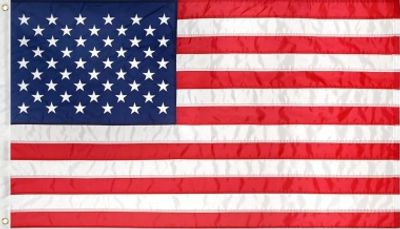
Pledge of Allegiance to the Flag

Pledge of Allegiance to the Flag
§4. Pledge of allegiance to the flag; manner of delivery
The Pledge of Allegiance to the Flag:
"I pledge allegiance to the Flag of the United States of America, and to the Republic for which it stands, one Nation under God, indivisible, with liberty and justice for all.",
should be rendered by standing at attention facing the flag with the right hand over the heart. When not in uniform men should remove any non-religious headdress with their right hand and hold it at the left shoulder, the hand being over the heart. Persons in uniform should remain silent, face the flag, and render the military salute. Members of the Armed Forces not in uniform and veterans may render the military salute in the manner provided for persons in uniform.
(Added Pub. L. 105–225, §2(a), Aug. 12, 1998, 112 Stat. 1494; amended Pub. L. 107–293, §2(a), Nov. 13, 2002, 116 Stat. 2060; Pub. L. 113–66, div. A, title V, §586, Dec. 26, 2013, 127 Stat. 777.)
United States Code, 2018 Edition
Title 4 - FLAG AND SEAL, SEAT OF GOVERNMENT, AND THE STATES
CHAPTER 1 - THE FLAG
Sec. 4 - Pledge of allegiance to the flag; manner of delivery
From the U.S. Government Publishing Office, www.gpo.gov
History of the United States Flag
History of the United States Flag
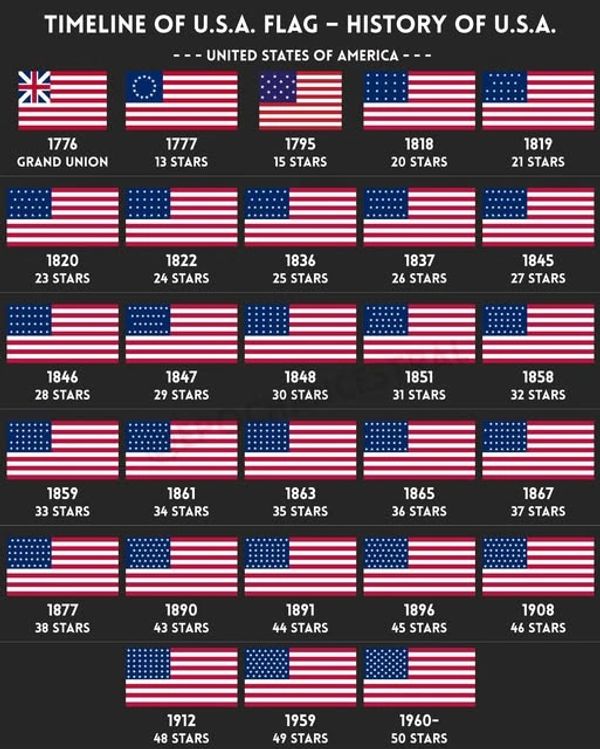
The U.S. flag evolved from early colonial banners into the current 50-star design. The first official flag was established on June 14, 1777 (now celebrated as Flag Day), featuring 13 alternating stripes and 13 stars representing the original colonies. The design has been officially updated 27 times. The history of the Stars and Stripes is defined by key milestones:
- 1775 – The Grand Union Flag: The first widely used flag retained the British Union Jack in the corner, representing the colonies' initial resistance without full separation from the British crown. [1]
- 1777 – The First Flag Act: The Continental Congress passed a resolution establishing a flag of 13 stars and 13 stripes to represent "a new constellation". The popular story of Betsy Ross sewing the first flag is largely folklore, though she did sew many early flags. [1, 2]
- 1795 – The 15-Star & 15-Stripe Flag: As Vermont and Kentucky joined the Union, Congress added a star and a stripe. This version flew over Fort McHenry in 1814, inspiring Francis Scott Key to write The Star-Spangled Banner. [1, 2]
- 1818 – The Flag Act: Recognizing that adding a stripe for every new state would eventually distort the flag, Congress permanently returned the stripes to the original 13. From this point on, a new star would be added to the blue union for each new state. [1, 2]
- 1960 – The 50-Star Flag: The most recent modification occurred when Hawaii became the 50th state in 1959. The current 50-star design has flown the longest, featuring nine alternating rows of six and five stars.
History of the U.S. Flag, in Paper (a 4 minute YouTube video)
Why the Betsy Ross Flag Is a Myth (a 10 minute YouTube video)
Betsy Ross flag (Wikipedia)
AMVETS Post 115 hosts US Flag History & Retirement Ceremonies typically on or around "Flag Holidays". See the Events page for details.
How to Display and Fold the United States Flag
How to Display the United States Flag
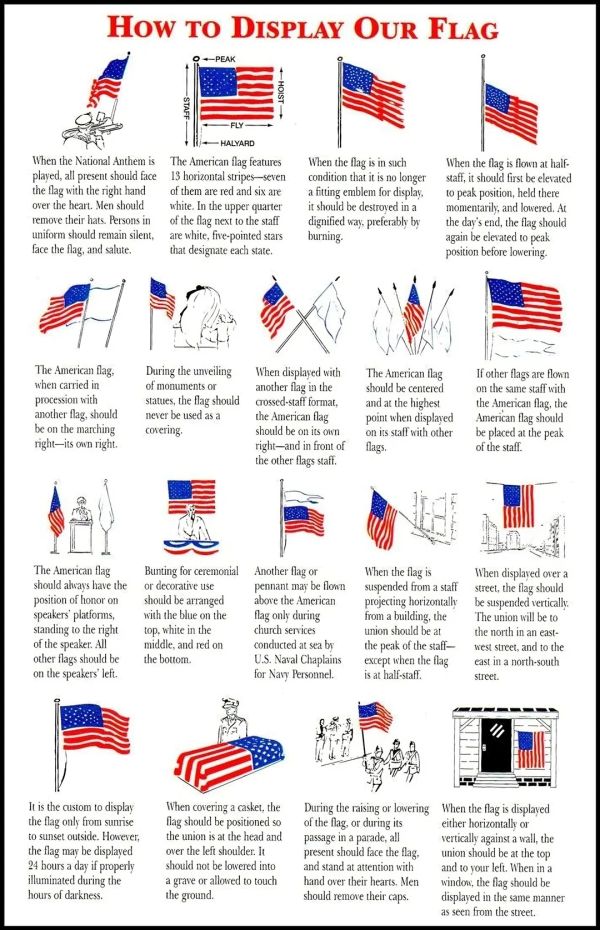
To display the American flag properly, always ensure the Union (the blue field of stars) is at the top left from the viewer's perspective. It should never touch the ground, be worn as clothing, or be flown in severe weather unless it is an all-weather flag. The display guidelines vary depending on your setup:
Hanging on a Wall or Window
- Horizontally or Vertically: The blue Union must always be at the top and to the observer's left.
- On a Door: Hang the flag flat so the Union is in the top-left corner as you face the door from the outside.
Flying on a Flagpole
- Highest Peak: The American flag must always be at the peak of the staff and above any other flags.
- With Other Flags: When flags are flown together on adjacent, equal-height poles, the U.S. flag must be to its own right (the viewer's left) and hoisted first.
- Half-Staff: To fly at half-staff, first hoist the flag to the peak momentarily, then lower it to the halfway point.
- Lighting: The flag should only be displayed from sunrise to sunset, unless properly illuminated at night.
For full federal guidelines and details on flag retirement, refer to the VFW Flag Etiquette guide or the VA.gov Flag Display Guidelines.
Flag etiquette dictates only flying your flag between sunrise and sunset unless it is properly illuminated. You should also take down Old Glory in the event of inclement weather except if it's an all-weather flag made out of a non-absorbent material like nylon. Only fly American flags in good condition, but as long as you follow these guidelines, your Stars and Stripes will last years to come.

How to Fold the United States Flag
Folding an American flag into a triangle is a ceremonial process that requires two people to keep the flag taut and ensure it never touches the ground. The final result should be a tight, triangular shape with only the blue field and white stars visible.
There are many websites and videos online with detailed instructions regarding how to properly fold the US flag. For example:
How to Retire the United States Flag

How to Retire the United States Flag
When an American flag is tattered or other unfit to be used, it should be disposed of by retirement. Retiring the flag with dignity requires, as outlined in the U.S. Flag Code, either burning or burying the flag. The most common approach is a dignified burning ceremony. If you are uncomfortable doing this yourself, local veteran posts and civic groups accept flags for proper disposal.
We recommend you bring the flag to be retired to our AMVETS Post 115 at 401 Veterans Drive or another veterans post. You can hand it to us when the post is open or leave it in the box labeled for that purpose in front of the post.
If you prefer you can retire the flag yourself, but bringing it to us, is easier for you and insures the flag if retired properly.
There are many websites and videos online with detailed instructions.
AMVETS Post 115 and the Flag

AMVETS Post 115 United States Flag Events
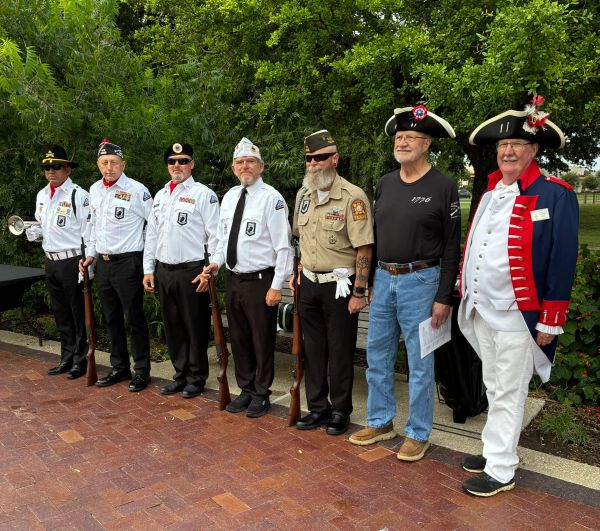
AMVETS Post 115 hosts US Flag History & Retirement Ceremonies typically on or around "Flag Holidays" and provided color guards for other civic events. See the Events page for details.
- National Holidays
Presidents' Day: Third Monday in February
Memorial Day: Last Monday in May
Juneteenth National Independence Day: June 19
Independence Day: July 4
Veterans Day: November 11
- Other Flag Holidays
Flag Day: June 14
Patriot Day: September 11
- Military Funerals
- Graduations & JROTC Events
- Flag Retirement Ceremonies
- Patriotic Ceremonies at other civic organizations
John W. Knox Presentations
At many Flag Retirement Ceremonies a History of the US Flag is presented by John W. Knox including dozens of flags from precolonial times through the present.
Among his credentials Mr. Knox is Commander of the Color Guard for the Texas Society of the Sons of the American Revolution and Past President of the Patrick Henry Chapter of the Sons of the American Revolution and a leading expert on the study of US Flags.
One of his "handouts" is a description of 24 of the many
Thirteen Star Flags & The Flag Resolution of June 14, 1776 (PDF)

How to Retire the United States Flag
When an American flag is tattered or other unfit to be used, it should be disposed of by retirement. Retiring the flag with dignity requires, as outlined in the U.S. Flag Code, either burning or burying the flag. The most common approach is a dignified burning ceremony. If you are uncomfortable doing this yourself, local veteran posts and civic groups accept flags for proper disposal.
We recommend you bring the flag to be retired to our AMVETS Post 115 at 401 Veterans Drive or another veterans post. You can hand it to us when the post is open or leave it in the box labeled for that purpose in front of the post.
If you prefer you can retire the flag yourself, but bringing it to us, is easier for you and insures the flag if retired properly.
There are many websites and videos online with detailed instructions.